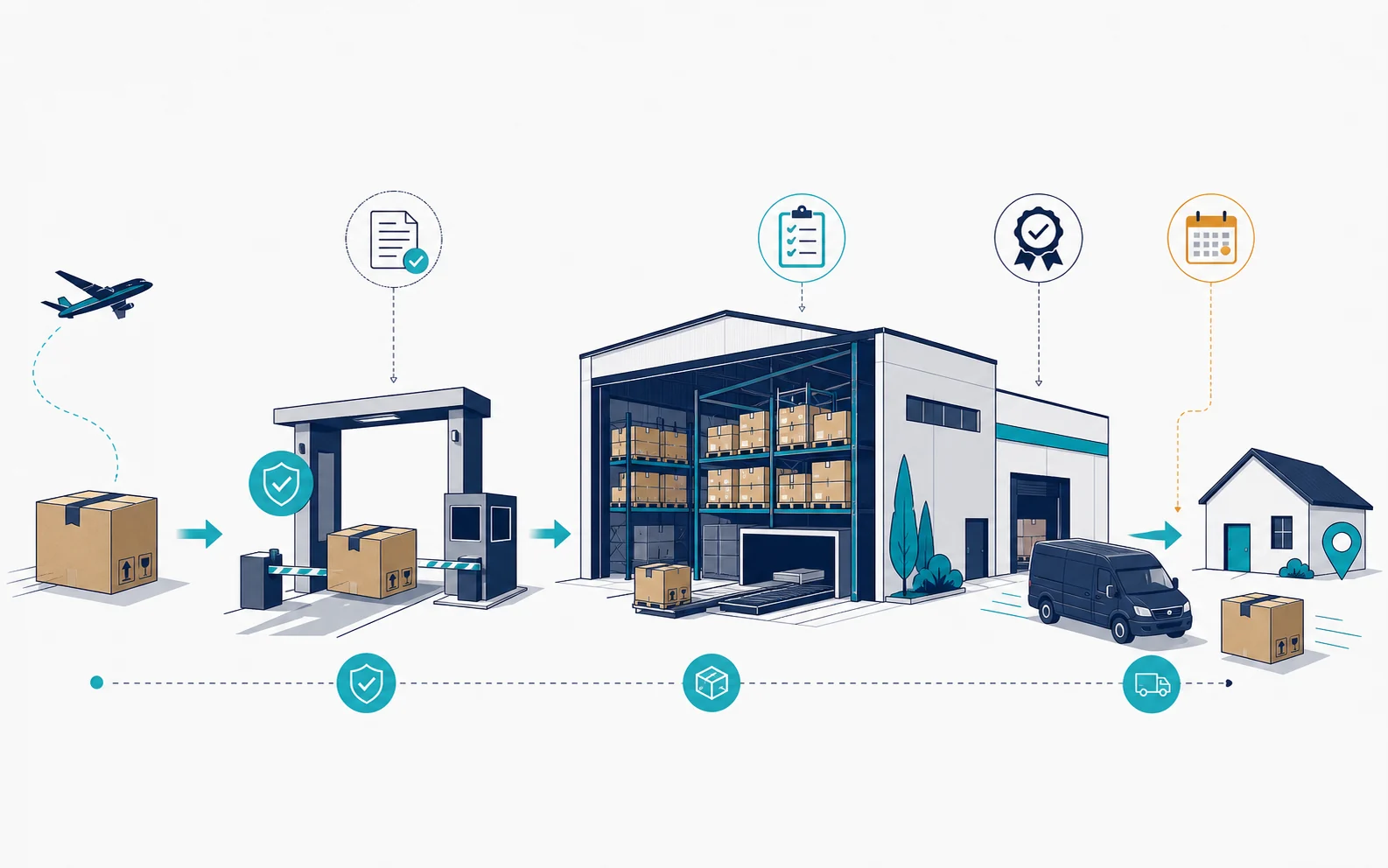
Holding stock in an Italian warehouse can cut delivery times, remove a customs crossing from each customer order and give an international brand a practical base inside the EU. It also creates obligations before the first pallet reaches the warehouse.
The point many brands miss is timing. Your first Italian VAT event may be the movement or import of your own goods, rather than the first order you ship to a customer. VAT registration, customs planning and product compliance therefore belong at the start of your fulfilment project.
Important disclaimer: Fulfilment4Italy is a logistics provider. We are not tax, legal or fiscal consultants. We prepared this article from public internet research and with AI assistance to collect, organise and draft the documentation. Rules depend on your business, products, contracts and sales flows, and they change. Always check your position with a qualified cross-border ecommerce tax and legal professional before moving stock or making a compliance decision. We recommend speaking to a specialist such as Alan Rhode at Taxmen.eu, who understands the legal and fiscal details that can bite an international ecommerce business.
The short version
Before you send stock to Italy, you will usually need to:
- establish how you will register and account for Italian VAT;
- map the VAT treatment of each sales flow from the Italian stock;
- decide who will act in the required customs roles if you are outside the EU;
- confirm that every product and its packaging can be sold in Italy;
- assess fixed-establishment and permanent-establishment risk with an adviser; and
- give your fulfilment provider the documents needed to receive and trace the goods.
Several workstreams can run together. The registration and customs work often takes the longest, so start it first.
If you want the commercial version of the warehouse model, see how brands hold stock in Italy and ship customer orders domestically.
1. Plan the Italian VAT registration before the stock moves
Moving your own goods from one EU country to another can create a deemed intra-EU transfer and acquisition under the EU VAT Directive. Importing goods from outside the EU creates a customs event, with duty and import VAT determined at the border.
In both cases, the stock movement can create an Italian reporting obligation before you make a customer sale. Do not use your planned launch date as the VAT deadline. Work backwards from the date the goods will arrive.
Direct identification or a fiscal representative?
Your route depends on where the business is established and on Italy's current reciprocity rules.
| Where the business is established | Route to investigate | Practical point |
|---|---|---|
| EU member state | Direct VAT identification in Italy | You can normally identify directly without appointing a fiscal representative. |
| United Kingdom or Norway | Italian tax-authority rulings recognise direct identification for UK and Norwegian businesses | Risoluzione 7/E/2021 covers the UK and Risoluzione 44/E/2020 covers Norway. Ask an adviser to confirm that your business and planned activities qualify. |
| Other non-EU country | Italian fiscal representative is usually required | The representative can carry joint liability and will conduct its own risk checks before accepting the appointment. |
Expect requests for a recent company-register extract, proof of home-country VAT registration, identification for the authorised signatory, translations and a description of the planned Italian activity. A fiscal representative may require security, deposits or extra documents. The separate €50,000 VIES guarantee applies to certain non-EU and non-EEA businesses operating through a fiscal representative; it does not apply to a UK business using direct identification or to a Norwegian business using that route. Allow weeks rather than days for the full process.
Call-off stock is not a general ecommerce workaround. The EU simplification has detailed conditions, including an intended business customer whose identity is known when the goods move. A warehouse pool held for future direct-to-consumer orders does not fit that model. “Consignment stock” is not a second legal exemption: unless the arrangement meets the call-off conditions, moving your own stock creates the usual transfer.
A third route: let somebody else be on the paperwork
The routes above assume you register, import and sell in your own name. Two tailored alternatives exist, and the distinction matters because the market often uses their names interchangeably.
Your company
You register, import and sell in your own name. Your advisers map the Italian VAT, customs and reporting position around your flows.
Importer of Record
An eligible EU-established party acts as declarant on the import and takes responsibility for the customs debt and import VAT. It solves the customs-party problem described below. The sales that follow remain yours, so you still need advisers to establish your Italian VAT position.
Merchant of Record
A Merchant of Record goes further and becomes the legal seller to the consumer, charging and remitting the VAT. A properly structured MoR arrangement can remove the brand's own Italian VAT registration because the consumer supply is no longer legally the brand's. The trade-offs include margin, control of the customer relationship, data and revenue recognition.
These structures depend on your contracts, industry and fiscal position. Our Importer and Merchant of Record page explains the two routes and the specialist partners who build them. It does not replace advice on which route fits your business.
2. Map each sales flow from the Italian warehouse
An Italian VAT number does not make a foreign company established in Italy. It also does not give every shipment the same VAT treatment.
| Goods move from Italy to | Typical VAT treatment to confirm |
|---|---|
| Italian consumer | Domestic Italian sale. Charge Italian VAT and report it through the Italian VAT registration. |
| Italian VAT-registered business | Italian reverse charge will often apply when the supplier is not established in Italy, even if it has an Italian VAT number. Configure the invoice flow with an Italian VAT adviser. |
| Consumer in another EU country | Destination-country VAT normally applies to an intra-EU distance sale. The Union OSS can often report these sales. |
| VAT-registered business in another EU country | An exempt intra-EU supply may apply when the customer has a valid VAT number and the supplier holds the required transport evidence and reporting records. |
| Customer outside the EU | Export VAT treatment may apply, alongside customs export requirements and evidence of exit. |
The EU One Stop Shop reduces the need for multiple VAT returns on eligible cross-border consumer sales. It does not replace the Italian registration used for domestic Italian sales, imports and stock movements.
The Italian business-to-business flow deserves attention. Italian law can shift the VAT accounting to the Italian customer when a non-established supplier makes a domestic supply. A foreign seller that charges Italian VAT because it holds an Italian VAT number can create recovery and correction problems for its customer. Have an adviser specify which VAT number appears on the invoice, who reports the transaction and how the Italian e-invoicing rules affect each customer type.
Italian VAT identification does not, by itself, make a non-established business subject to the domestic electronic-invoicing mandate, which applies to persons resident or established in Italy. Many foreign registrants still use the Sistema di Interscambio (SdI) voluntarily because Italian business customers and accounting systems expect it. Ask your Italian adviser to design the practical invoice flow.
Intrastat is separate again. From the January 2026 reporting period, the quarterly-acquisition threshold that triggers monthly statistical INTRA-2 bis reporting rose from €350,000 to €2,000,000. This is a statistical threshold, not a VAT exemption. Consumer distance sales do not belong in INTRA-1 bis as intra-EU business supplies.
Your product's VAT rate also needs a classification check. A marketing label such as “food supplement” does not decide the rate by itself. Customs classification, ingredients and presentation can change the answer. Obtain a written classification opinion where a reduced rate has a material effect on margin.
3. Separate VAT fixed establishment from corporate-tax permanent establishment
Teams often combine two different questions:
- Does the Italian operation create a fixed establishment for VAT?
- Does it create a permanent establishment for corporate income tax?
The tests and consequences differ.
VAT fixed establishment
An Italian VAT number alone does not create a fixed establishment. The EU VAT Implementing Regulation looks for enough permanence and suitable human and technical resources. Stock in a third-party warehouse will not, by itself, answer that test.
The contract and the operation still matter. A client with personnel on site, dedicated resources under its control or an operation that functions as part of its own organisation presents a different fact pattern from a standard shared-warehouse service.
Corporate-tax permanent establishment
Income-tax treaties and Italian law examine whether the business has a fixed place available to it or whether someone in Italy plays a material role in concluding contracts. Storage and delivery may fall within treaty exclusions where they remain preparatory or auxiliary, but the full activity and any related Italian operations must be considered.
Good operational boundaries include:
- shared warehouse space rather than an exclusive client area;
- no client employees working at the warehouse;
- no authority for warehouse staff to negotiate or conclude the client's sales contracts;
- pricing, buying and commercial decisions made outside Italy; and
- a fulfilment scope centred on receipt, storage, pick, pack, dispatch and agreed compliance tasks.
These boundaries support a standard third-party logistics relationship. They do not replace a tax analysis of your contracts and operating model.
4. Non-EU brands need a customs plan in both directions
An EORI number is only the start. You also need to decide who will make the import declaration, who bears the customs debt and who can act as exporter when goods leave the EU.
Article 170 of the Union Customs Code generally requires a customs declarant to be established in the EU. “Importer of Record” is a commercial label, not a role defined by the Code. A non-EU brand may therefore need indirect customs representation or an Importer of Record service. Record separately who is the commercial importer, who signs as declarant and who owes or supports the customs debt and import VAT. Under indirect representation, the representative acts in its own name on the brand's behalf and shares exposure to customs debt. Brokers price and secure that risk.
The 2026 removal of the €150 customs-duty relief makes the stock-location decision more visible. From 1 July 2026 until 1 July 2028, covered distance-sale consignments worth no more than €150 carry a temporary €3 duty per customs-declaration item. “Item” does not mean each physical unit: one or more goods can form one item when they share the same tariff classification, description and, where declared, origin. Five identical T-shirts can therefore be one €3 item, while a T-shirt and a watch can be two. Check the Commission's current guidance for VAT-scheme and declaration exceptions. Product identifiers become mandatory on the covered declarations from 1 November 2026. Our guide to the 2026 EU customs reset explains why a single bulk import can be cheaper than a customs event on every customer order.
Exports need their own design. The customs “exporter” must satisfy the establishment and control requirements in the Union Customs Code Delegated Regulation. A bare administrative power of attorney does not supply missing decision-making authority, although a genuine contractual mandate may. The document's title is not decisive; real authority is. Your contracts, Incoterms and customs instructions must identify an eligible EU party with the required authority over the export.
Agree the document flow with your broker before the first shipment. Your finance team needs the import declaration references and the Italian evidence required to support import VAT deduction. Goods also need clear transport and deposit documents so an inspection can distinguish client-owned stock from warehouse-owned goods.
If volumes justify it, ask a customs specialist whether a customs warehouse or VAT warehouse could suspend duty or VAT until goods enter the relevant market. These regimes add controls and do not suit every catalogue.
5. Product compliance can stop the inbound before VAT does
A VAT number does not make a product legal to sell. Before the warehouse receives a SKU, confirm the EU economic operator, labels, registrations, packaging obligations and any conformity documents required by the law applicable to that product.
The General Product Safety Regulation has applied since 13 December 2024. Products in its scope need a responsible economic operator established in the EU. Depending on the supply chain, this can be the manufacturer, importer, authorised representative or, where no other qualifying operator exists, a fulfilment service provider that offers at least two of warehousing, packaging, addressing and dispatching. A non-EU brand should identify the correct responsible person before shipping stock to a 3PL.
Fulfilment4Italy asks non-EU clients for the responsible person's postal and electronic contact details and for conformity or technical documents where the applicable sector law requires them. A declaration of conformity or technical file is not universal. Operator details may appear on the product, packaging, parcel or accompanying document where the applicable rules permit.
Checks that affect many product categories
- Italian-language consumer information. Mandatory warnings, instructions and other consumer information must be understandable in the market where the product is sold. Check the rules for your category rather than translating the front label alone.
- Packaging and EPR. Businesses placing packaged goods on the Italian market may have registration, reporting and environmental-contribution duties connected with CONAI. A foreign business without an Italian establishment is generally not automatically required to join CONAI under the ordinary rules; often the Italian importer carries the position. Ecommerce and EPR rules can change the analysis, so obtain client-specific confirmation. The EU Packaging and Packaging Waste Regulation has applied since 12 August 2026. In particular, food-contact packaging placed on the market from that date must comply with the PPWR's PFAS concentration limits. Other applicable substance, conformity and economic-operator requirements also need checking, while labelling, recycled-content, recyclability and empty-space rules arrive in later stages.
- Traceability. Batch, expiry and inbound records need to follow the goods through storage and dispatch where the product rules require them.
- Online listings. Product pages can require safety, economic-operator, energy, charging or other information. A compliant box does not make an incomplete online offer compliant.
Category-specific examples
| Category | Questions to settle before inbound |
|---|---|
| Food supplements | Ministry of Health notification, permitted ingredients, claims, Italian labels, operator details, batch and expiry traceability. The Ministry notification code may be shown voluntarily; it is not mandatory on the pack. The responsible EU-established food-business operator is not necessarily the customs importer. See our guide to selling supplements in Italy. |
| Cosmetics | EU Responsible Person, CPNP notification, Product Information File, safety report and Italian mandatory particulars. Acting as the customs importer or “Importer of Record” does not, by itself, make that party the cosmetics Responsible Person. The cosmetics importer is the default Responsible Person, but may designate another EU person by written mandate. |
| Pet food | Feed-business requirements, Italian label particulars, composition, additives, batch, durability and traceability. |
| Fashion and footwear | Fibre composition, durable Italian labelling where required, and footwear material identification. |
| Electronics | CE documentation where the applicable harmonisation law requires it; importer or responsible-operator details in the permitted location; WEEE registration with a collective or approved individual financing system; and battery registration for the party that first makes the batteries available in Italy, including batteries incorporated in an appliance or supplied in the box. |
Alcohol under excise suspension and products close to a regulatory borderline may need dedicated facilities or additional roles. Medical-device duties are role-dependent: an ordinary distributor or 3PL is not universally subject to a manufacturer's quality-management system, EUDAMED actor registration or warehouse authorisation. Raise these categories before asking for an inbound booking so the actual role and product can be checked.
Calendar: future dates to watch
Product identifiers on low-value importsProduct identifiers become mandatory on the customs declarations covered by the EU's temporary low-value import rules. Catalogue and broker data need to carry the correct identifiers.
Italy's VAT code and EU scheme clarificationsItaly's 171-article Testo Unico IVA starts to apply, replacing the legacy numbering used in many contracts, procedures and adviser notes. The first VAT in the Digital Age clarifications also affect OSS and IOSS users. Ask your provider to update citations, reporting and correction procedures.
EU textile EPR backstopMember states must apply textile and footwear extended-producer-responsibility rules by this date, with an extra year for microenterprises. Italy may act earlier, so fashion brands should monitor the national implementation.
Customs and VAT change togetherThe temporary €3 low-value customs duty ends. The enacted Single VAT Registration reforms also start, including an own-goods transfer module and a wider mandatory reverse charge. No new call-off-stock arrangement can start after 30 June 2028. The separate EU Customs Data Hub start date has been politically agreed but not yet enacted as at 28 August 2026; confirm the final legislation before planning around it.
Harmonised EU sorting labelsThe PPWR timetable introduces harmonised material-composition labels from this date or 24 months after the relevant implementing act enters into force, whichever is later. Ecommerce packaging is within scope, so confirm the final act and label specification before printing long packaging runs.
Call-off-stock simplification endsArticle 17a of the VAT Directive ceases to apply. Qualifying arrangements that began by 30 June 2028 can continue only under their existing conditions, including the 12-month ownership-transfer limit, and must be resolved by this date.
Packaging design rules tightenSeveral PPWR design duties start on 1 January 2030 or three years after the relevant implementing act, whichever is later. These include recyclability and recycled-content requirements and the 50% maximum empty-space ratio for grouped, transport and ecommerce packaging. Confirm the final timetable before changing packaging.
Cross-border B2B digital reportingEU digital reporting requirements start for cross-border B2B transactions under the VAT in the Digital Age timetable.
6. Use this pre-arrival checklist
Work through the following list with your tax adviser, customs broker, product-compliance specialist and fulfilment provider:
- Choose the Italian VAT registration route and complete it before the relevant stock movement or import.
- Confirm whether the warehouse address needs to be declared in your Italian registrations or records.
- Document the VAT and invoice treatment for every B2C and B2B sales flow.
- Set up Union OSS where it applies to cross-border EU consumer sales.
- Obtain an EORI number and appoint the required import and export customs parties.
- Name the correct EU responsible economic operator for each product.
- Complete Italian labels, sector notifications, packaging/EPR work and any technical files required by the applicable sector law.
- Give the 3PL the inbound, ownership, batch, expiry and recall information it needs.
- Keep client staff, commercial decision-making and contract authority outside the warehouse operation unless your tax adviser has assessed the structure.
- Test one complete order flow before launch, including the invoice, VAT report, carrier documents and returns process.
Fulfilment starts after the compliance decisions
Fulfilment4Italy can help you translate the agreed structure into warehouse operations: receiving documents, stock ownership records, batch and expiry capture, pick and pack rules, carrier setup, returns and recall traceability. We can also explain what our sites and processes can support when you sell in Italy.
We cannot choose your VAT position, act as your tax adviser or certify that your product is legal for the Italian market. Those decisions belong with qualified specialists who can review your company, contracts, products and sales flows.
Frequently asked questions
Do I need an Italian VAT number to store stock in Italy?
A business that owns stock in Italy and moves, imports or sells those goods will usually need an Italian VAT position. The precise trigger depends on the stock route and sales flow. A properly structured Merchant of Record arrangement can change who makes the consumer supply, so confirm the answer before the goods move.
When do I need to register: before the stock arrives or before the first sale?
Register before the import or intra-EU stock movement that creates the Italian VAT obligation. The first taxable event can happen when your own goods reach Italy, before the first customer order.
Does using an Italian 3PL create a permanent establishment?
Not automatically. A standard shared-warehouse contract, without your staff or commercial decision-making in Italy, differs from resources that your business controls as part of its own operation. VAT fixed-establishment and corporate-tax permanent-establishment tests are separate and fact-specific.
Can a non-EU company be the importer of record in Italy?
“Importer of Record” is a commercial label. The Union Customs Code generally requires the declarant to be established in the EU, so a non-EU brand may need indirect customs representation or an Importer of Record service. The contract must separately identify the commercial importer, the declarant and the party responsible for customs debt and import VAT.
Before you move stock: this article is general information based on public internet research, with AI used to help collect, organise and draft the material. It is not tax, legal, customs or product-compliance advice. Fulfilment4Italy is not a fiscal consultancy. Ask a cross-border ecommerce specialist, such as Alan Rhode at Taxmen.eu, and the relevant Italian professionals to verify your setup. The small legal and fiscal details are often the ones that become expensive later.
Once your advisers have confirmed the structure, talk to Fulfilment4Italy about making the warehouse and fulfilment side work.
Sources and further reading
- Council Directive 2006/112/EC on the common system of VAT
- European Commission: VAT One Stop Shop
- Council Implementing Regulation (EU) No 282/2011
- Regulation (EU) No 952/2013: Union Customs Code
- Commission Delegated Regulation (EU) 2015/2446
- Regulation (EU) 2023/988: General Product Safety Regulation
- Regulation (EU) 2025/40: Packaging and Packaging Waste Regulation
- European Commission: VAT in the Digital Age
- Directive (EU) 2025/516: ViDA and the phase-out of call-off stock
- Implementing Regulation (EU) 2026/1869: special scheme for transfers of own goods
- European Commission: temporary duty and product identifiers for low-value imports
- Commission Delegated Regulation (EU) 2026/1022: definition of an item for the temporary customs duty
- ISTAT: 2026 Intrastat acquisition threshold
- D.Lgs. 10/2026: Testo Unico IVA
- D.Lgs. 29/2026: Italian battery rules and producer register
- Regulation (EC) No 1223/2009: cosmetics and the Responsible Person
- Directive (EU) 2025/1892: textile and footwear extended producer responsibility
- Italian tax authority: direct-identification rulings for the UK and Norway
- Agenzia delle Entrate: scope of the electronic-invoicing mandate
- CONAI: plastic packaging contributions from 1 October 2026
- European Commission guidance on Regulation (EU) 2025/40
- Taxmen.eu
Prepared and checked against primary official sources on 28 August 2026. Future implementing dates remain conditional where stated.